

Sixthfin UK Financial Close Automation Research Finds Account Reliability the Top Priority for 67% of Enterprise Finance Teams and Only 42% Satisfied With Close Management
A 2026 study of 303 UK CFOs finds that account reliability, rather than close speed, is the priority for finance leaders, with 67% naming it their main objective for improving the close and only 42% describing close management as very satisfactory. The findings reframe what financial close automation software means for UK enterprises: automating controls, automating the analysis of complete data populations rather than samples, and automating balance sheet reviews. They also indicate where the benefits, cost savings and ROI of accounting close process automation are concentrated for large finance teams comparing close solutions.
London, United Kingdom, Sept. 14, 2026 (GLOBE NEWSWIRE) -- UK enterprise finance teams are not principally asking for a faster financial close. They are asking to trust its output. In new research among 303 UK CFOs, 67% name improving the reliability of accounts as their top priority for improving the close, ahead of reducing delays at 57%, while only 42% describe the way their organisation manages the close as very satisfactory.
The findings come from the Sixthfin Report on Accounting Transformation, conducted by Odoxa for Sixthfin among CFOs at large and mid-sized private UK companies who are personally involved in their organisation's monthly or periodic close. The full study is available at https://sixthfin.com/en/resource/sixthfin-report-on-accounting-transformation/
The results point to a shift in what financial close automation needs to mean for large organisations. Much of the last decade of investment automated the production of accounting information: transactions, postings, and the mechanics of getting a period closed. What the survey identifies as unresolved sits after that stage, in the review of what was produced. On that reading, close automation for enterprise finance covers three things: the automation of controls, so that testing is standardised and repeatable across entities rather than dependent on who performs it; the automation of analysis across complete data populations rather than samples, so that small or repeated anomalies are visible instead of being missed between sampling intervals; and the automation of balance sheet reviews, so that account analysis and justification are structured, documented and comparable period to period.
The tooling picture explains why that work is still largely manual. Excel is used to analyse and justify accounts at 67% of companies, level with ERP systems at 67%. Collaborative tools such as Teams and email are used at 61% and custom-developed internal tools at 38%. Just 3% use a dedicated account reconciliation solution, and only 15% carry out account analysis and reconciliation without relying on Excel or collaborative tools. Just 3% use a dedicated solution for account reconciliation in the sense of balance sheet substantiation and justification, rather than transaction matching, and only 15% carry out this work without relying on Excel or collaborative tools.
The work is compressed as well as manual. 74% of companies complete the close in three to eight days, and the close has an important impact on workload at 97% of companies and on team motivation at 93%. Deadlines are a source of stress for teams at 96% of companies, the quality of available tools at 93%, constraints from parallel projects at 88%, the unreliability of data at 86% and the lack of time for analysis at 86%.
Sources of complexity are organisational rather than technical. Late collection of information is cited by 44% of CFOs as a factor complicating the close, multiple Excel files by 38%, dependence on certain key individuals by 35%, lack of coordination between teams by 34% and difficulties with traceability and account documentation by 34%. Inappropriate tools rank last, at 14%.
The consequences are not confined to the finance function. Close output feeds statutory reporting, audit, board reporting and operational decisions, so where reliability is in question the cost is generally incurred after the close has finished, in audit queries, revisited figures and decisions taken on numbers that later require explanation. At 93% of companies the close affects team motivation, and 50% of CFOs name analytical thinking as the main skill accountants will need in future, at a point when much of that capacity is consumed by assembling the numbers rather than examining them.
"The past decade has been defined by the automation of transactions. ERP modernisation, RPA and reconciliation tools have significantly improved the efficiency of accounting processes. Yet our research suggests the constraint has simply shifted downstream. Today, the greatest pressure sits within the review process itself. Finance teams are looking for greater confidence in their accounts. The next phase of finance transformation will therefore be about automating controls, analytical reviews and risk detection, enabling teams to reach the same reporting deadlines with more complete analysis and stronger assurance," said François Vallana, CEO of Sixthfin.
The activities CFOs most want to strengthen support that reading. Analysis and justification of accounts was selected by 53%, analytical review of the balance sheet and income statement by 50%, and checking and validating manual entries by 50%. Calculation of closing entries followed at 45%, reconciliation of positions at 32% and intragroup reconciliations at 29%.
Sixthfin Closing, the company's enterprise financial close platform, is built around that review layer. It structures balance sheet reviews, account analysis and justification, standardises controls across entities, centralises financial information from different source systems to reduce fragmentation and manual reprocessing, and builds traceability of the work and documentation of controls into the process itself rather than reconstructing evidence afterwards. The platform structures and documents this review work rather than performing transaction level matching, which typically sits in ERP or dedicated reconciliation tools. Users can move from consolidated financial information into individual accounting transactions. The platform is ERP and chart of accounts agnostic; Sixthfin reports 38 ERP systems connected across deployments in more than 70 countries, with more than 1,000 companies and groups covered by its technology in 2024.
Artificial intelligence is part of that direction of travel, and finance leaders are broadly open to it. 84% of surveyed CFOs said they trust AI for the automation of repetitive and time-consuming accounting tasks and 80% for improving the reliability and control of figures and detecting anomalies, although on every application tested fewer than half said they trust it absolutely. Automating accounting activity is a different proposition from demonstrating that the resulting numbers have been reviewed, reconciled, and controlled and are audit-ready.
Sixthfin says Closing can save approximately six days per accountant per year and deliver up to three times greater efficiency in controls and investigations, with results dependent on existing systems, close processes, entity structure and deployment scope.
For UK enterprises assessing the return on financial close automation, the calculation therefore extends past the number of close days. It covers the time spent collecting information, justifying accounts, investigating anomalies, documenting reviews and coordinating activity across entities, and whether the organisation can demonstrate the reliability of what it reports.
For more information about Sixthfin or to request a demonstration, visit https://sixthfin.com/en/
Survey Methodology
Online survey conducted by Odoxa from March 11-23, 2026, among a sample of 303 CFOs at private UK companies with 250 or more employees, representative of UK companies of that size. Only respondents involved in their organisation's monthly or periodic financial close were surveyed. Representativeness was ensured through quota sampling on industry sector, company size and region. The sample comprised 227 CFOs from companies employing 250 to 4,999 people and 76 from companies employing 5,000 or more, with each category weighted to reflect its actual proportion. For a sample of this size, the margin of error ranges from 2.5 to 5.8 percentage points at a 95% confidence level, depending on the observed percentage.
About Sixthfin
Sixthfin develops financial data control and financial close technology for complex organisations. Its Closing platform structures balance sheet reviews, account analysis and justification, control standardisation, collaborative workflows, documentation and transaction level investigation across multi-entity and multi-ERP environments. Sixthfin technology is deployed in more than 70 countries, connects to 38 ERP systems and covered more than 1,000 companies and groups in 2024, working across charts of accounts, currencies and accounting frameworks without requiring organisations to replace their underlying financial systems. The company has offices in London and Paris.
Attachment

Cécile Mana
1 Waterhouse Square
London EC1N 2ST, United Kingdom
+44 7 517 614 077

UK Financial Close Automation Platform
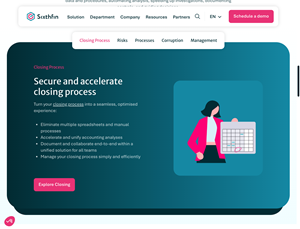
The Sixthfin platform accelerates and strengthens processes at every step: unifying data and procedures, automating analysis, speeding up investigations, documenting controls, and guiding decisions.
Legal Disclaimer:
EIN Presswire provides this news content "as is" without warranty of any kind. We do not accept any responsibility or liability for the accuracy, content, images, videos, licenses, completeness, legality, or reliability of the information contained in this article. If you have any complaints or copyright issues related to this article, kindly contact the author above.
