

A roadmap for self-powered tactile sensors in robots and wearables
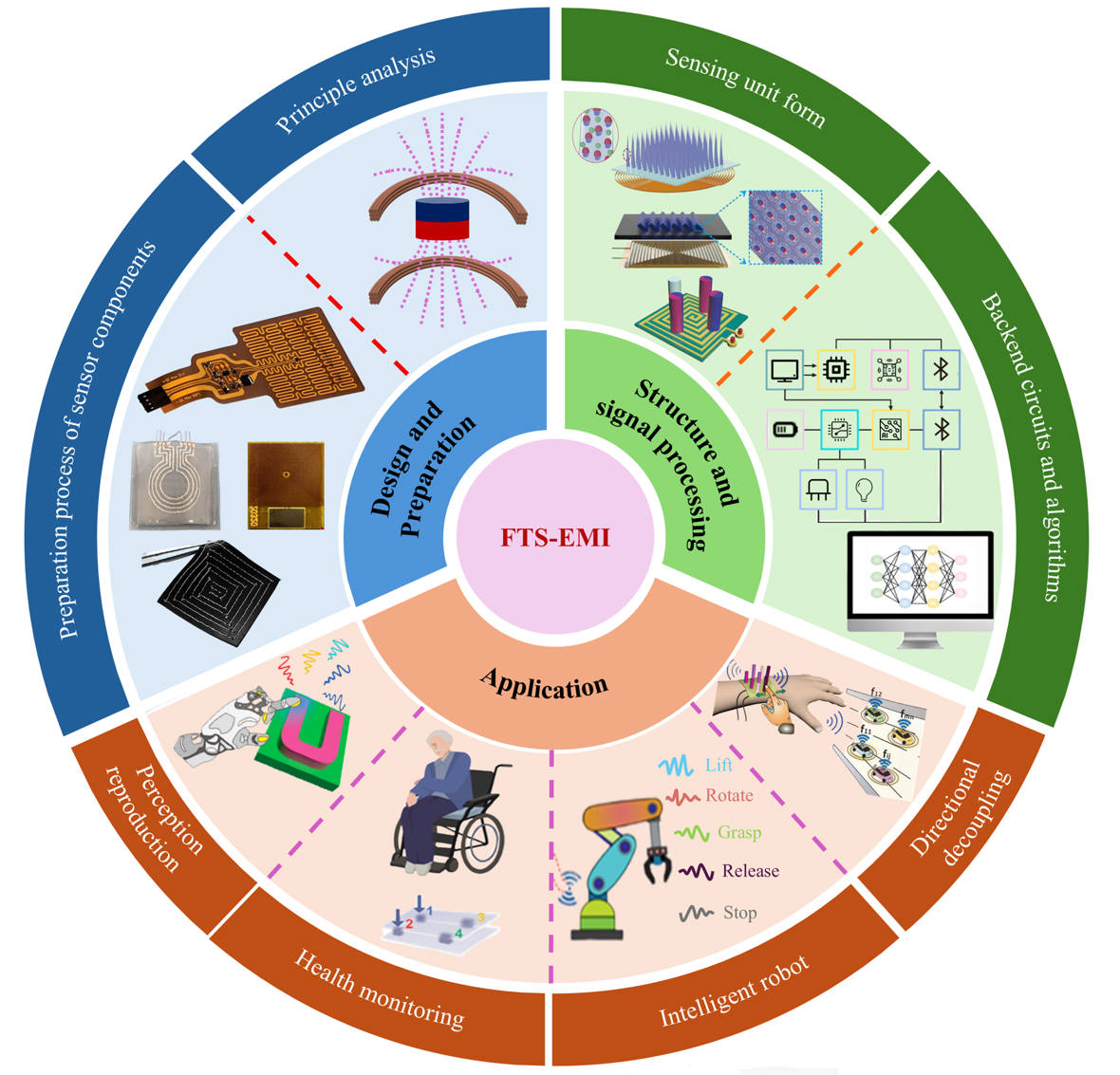
Overview Of Flexible Electromagnetic Induction-Type Tactile Sensors (Fts-Emi), Connecting Principle Analysis, Fabrication And Structural Design, Signal Processing, And Applications.
GA, UNITED STATES, July 16, 2026 /EINPresswire.com/ -- This review summarizes flexible electromagnetic induction-type tactile sensors that convert touch-induced magnetic-flux variation into electrical signals. It establishes an integrated framework linking magnets, coils, soft materials, signal processing and circuits, and discusses their relevance to wearable electronics, medical monitoring, human-machine interfaces and intelligent robotics.
Accurate tactile perception remains a challenge for robots, wearable devices and medical monitors. Although many flexible tactile sensors conform to the human body and other curved surfaces, they may require external power, show signal drift, or experience reduced reliability under humid, high-temperature or large-deformation conditions.
A review by researchers North University of China examined flexible electromagnetic induction-type tactile sensors, or FTS-EMI. These sensors operate through touch-induced relative motion between a magnet and a coil, which changes the magnetic flux and generates an electrical output. This operating principle enables dynamic contact sensing without an external bias voltage and provides a promising route for low-power, robust and self-powered tactile interfaces.
“FTS-EMI should be considered as an integrated sensing system rather than as a set of independent materials or circuits,” says co-corresponding author Xiaojuan Hou. “We emphasized the coordinated design of the magnet, coil, flexible mechanical structure and signal-processing pathway.”
The team did not just focus on a single device demonstration. Instead, they provided a systematic roadmap for the development of the field and identifies the need for application-oriented design, standardized performance evaluation and multimodal integration with piezoelectric, capacitive or resistive mechanisms. “These directions may support the transition of flexible tactile sensors toward more efficient, reliable and practical intelligent systems,” says Hou.
Notably, the researchers organized the field using a three-layer framework comprising fabrication process, structural design and backend processing. “We examined how permanent magnets, flexible coils, magnetic soft composites, bionic structures, microcolumn arrays, circuits and algorithms jointly determine sensor performance,” says Hou. “Furthermore, we summarized applications in fingertip-like tactile sensing, multidimensional force decoupling, health monitoring, wearable electronics, human-machine interaction and intelligent robots.
“Because electromagnetic-induction tactile sensors can generate electrical outputs directly from contact-induced motion, they are well suited to low-power tactile interfaces,” says senior and co-corresponding author Jian He. “This feature is particularly relevant for wearable electronics and robotic systems operating under complex mechanical or environmental conditions.”
Accurate tactile perception remains a challenge for robots, wearable devices and medical monitors. Although many flexible tactile sensors conform to the human body and other curved surfaces, they may require external power, show signal drift, or experience reduced reliability under humid, high-temperature or large-deformation conditions.
A review by researchers North University of China examined flexible electromagnetic induction-type tactile sensors, or FTS-EMI. These sensors operate through touch-induced relative motion between a magnet and a coil, which changes the magnetic flux and generates an electrical output. This operating principle enables dynamic contact sensing without an external bias voltage and provides a promising route for low-power, robust and self-powered tactile interfaces.
“FTS-EMI should be considered as an integrated sensing system rather than as a set of independent materials or circuits,"says co-corresponding author Xiaojuan Hou. "We emphasized the coordinated design of the magnet, coil, flexible mechanical structure and signal-processing pathway.”
The team did not just focus on a single device demonstration. Instead, they provided a systematic roadmap for the development of the field and identifies the need for application-oriented design, standardized performance evaluation and multimodal integration with piezoelectric, capacitive or resistive mechanisms. "These directions may support the transition of flexible tactile sensors toward more efficient, reliable and practical intelligent systems," says Hou.
Notably, the researchers organized the field using a three-layer framework comprising fabrication process, structural design and backend processing. "We examined how permanent magnets, flexible coils, magnetic soft composites, bionic structures, microcolumn arrays, circuits and algorithms jointly determine sensor performance,"says Hou. "Furthermore, we summarized applications in fingertip-like tactile sensing, multidimensional force decoupling, health monitoring, wearable electronics, human-machine interaction and intelligent robots
“Because electromagnetic-induction tactile sensors can generate electrical outputs directly from contact-induced motion, they are well suited to low-power tactile interfaces,"says senior and co-corresponding author Jian He. "This feature is particularly relevant for wearable electronics and robotic systems operating under complex mechanical or environmental conditions.”
References
DOI
10.1016/J.WEES.2026.03.003
Original Source URL
https://doi.org/10.1016/J.WEES.2026.03.003
Funding information
This work was supported by the National Natural Science Foundation of China, the Fundamental Research Program of Shanxi Province, and the China Postdoctoral Science Foundation.
Lucy Wang
BioDesign Research
email us here
Legal Disclaimer:
EIN Presswire provides this news content "as is" without warranty of any kind. We do not accept any responsibility or liability for the accuracy, content, images, videos, licenses, completeness, legality, or reliability of the information contained in this article. If you have any complaints or copyright issues related to this article, kindly contact the author above.
