Hard Rock Penetration Analysis: Why This Professional Advanced Percussion Drill Factory Leads the Market
LANGFANG, CHINA, June 29, 2026 /EINPresswire.com/ -- When executing deep-hole boring operations in highly competent geological formations like granite, quartzite, or basalt, structural integrity and mechanical efficiency are non-negotiable. Subsurface operations demand equipment capable of breaking compressive strengths exceeding 150 to 200 MPa without buckling under continuous thermal and kinetic loads. For field operators, encountering premium geological strata means dealing with high abrasive wear, excessive tool chatter, and the constant threat of internal piston seizing. In these unforgiving environments, selecting the right manufacturing partner becomes the thin line between project profitability and costly downtime. As a Professional Advanced Percussion Drill Factory, SHENLI must design systems that withstand these extreme variables, providing high-frequency impact energy while maintaining structural stability over extended operational shifts.
Analysis 1: Hard Rock Strata Categorization and SHENLI Performance Metrics
To fully appreciate the engineering rigor required to dominate the global market, one must examine how specialized equipment interfaces with specific, highly abrasive geological matrices. Standard market drills frequently experience immediate component degradation when transitioning between varying strata. In contrast, advanced percussion units are mechanically mapped to overcome the unique crystalline thresholds of the world's most challenging rock types:
Quartzite (Mohs Hardness 7; Scale f = 15 - 20; Compressive Strength >200 MPa): This abrasive, silica-rich formation causes severe gauge wear. SHENLI equipment counters this with optimized piston stroke lengths that deliver a concentrated, single-blow impact energy of 80J to 100J, successfully shearing the ultra-dense silica bonds without causing the internal components to fracture under kinetic feedback.
Granite (Mohs Hardness 6 - 7; Scale f = 12 - 15; Compressive Strength 120 - 180 MPa): Granite demands highly sustained wave propagation. The factory's synchronized valve technology maintains a precise frequency of 35Hz to 45Hz, producing steady, radial tensile fractures slightly ahead of the bit face to achieve continuous, non-stalling penetration.
Basalt (Mohs Hardness 5 - 6; Scale f = 10 - 14; Compressive Strength 150 - 250 MPa): This dense volcanic rock resists fracturing and is notorious for trapping drill steels. To mitigate this risk, the machinery integrates independent, high-torque rifle bars that deliver immense rotational indexing power alongside a 70J percussive wave, preventing the drill string from binding mid-hole.
Iron Ore & Quartz Diorite (Mohs Hardness ~6; Scale f = 10 - 12; Compressive Strength 100 - 150 MPa): High metallic mineral densities require absolute stability during continuous boring. Supported by heavy-duty pneumatic air legs, these drills maintain a uniform axial forward thrust, ensuring that all kinetic energy is forced directly into the rock face.
Analysis 2: Comparative Material Engineering and Component Failure Mitigation
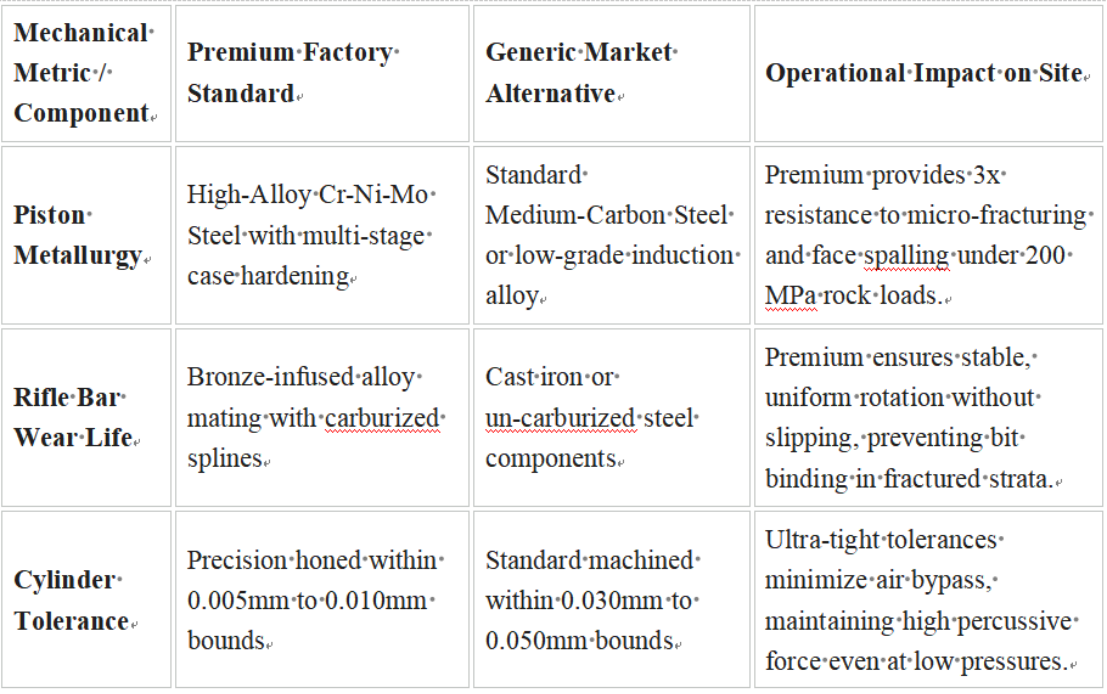
A rigorous comparative analysis between market-leading equipment and standard, generic alternatives reveals that the primary differentiator lies in metallurgy and specialized thermal treatments. Generic manufacturers frequently utilize standard carbon steels or substandard alloys for critical internal components like pistons, rifle bars, and chuck bushings to minimize baseline production costs. Under the punishing, continuous stress of high-frequency operation, these inferior metals quickly succumb to cyclic fatigue, manifesting as micro-fractures along the piston striking face or premature stripping of the rifle bar splines. When these internal components deform, the machine experiences severe internal friction, leading to a massive drop in torque and causing the unit to choke or seize entirely during deep-hole operations.
In contrast, an advanced Percussion Drill factory utilizes premium alloy steels infused with precise ratios of chromium, nickel, and molybdenum to maximize core toughness and surface hardness. Critical stress components undergo multi-stage gas carburizing and computer-controlled induction hardening procedures. This advanced metallurgical approach creates a dual-layered material profile: a highly resilient, shock-absorbing internal core that prevents catastrophic cracking under high impact, enclosed by an ultra-hard, wear-resistant outer skin that resists scratching and scoring from abrasive rock dust.
Furthermore, component precision plays a critical role in preventing localized overheating. When a cylinder is honed to micro-metric tolerances, the clearance between the reciprocating piston and the inner cylinder wall is perfectly uniform. This tight seal ensures optimal compression while allowing a fine, atomized film of rock drill oil to coat every moving surface. By eliminating these minor variances during the machining stage, advanced factories deliver tools that operate at significantly lower internal temperatures, guaranteeing a long service life and reliable field operation where generic units frequently fail.
Analysis 3: Field Application Mapping and Engineering Case Study of the S83 Model
Deploying heavy-duty drill equipment requires a deep understanding of specific field environments, as a tool optimized for an open-pit quarry may require completely different operational configurations when deployed in a deep underground mine or a narrow transport tunnel. For underground mining operations, space constraints and ventilation management are primary concerns. Equipment must deliver exceptional power-to-weight ratios, allowing operators to position and operate setups in confined stopes without inducing excessive operator fatigue. In these dark, damp underground environments, miners require a reliable Drill For Mining that integrates seamlessly with robust air-leg configurations to maintain uniform forward thrust against vertical and inclined rock faces.
To fully understand how advanced manufacturing principles translate into real-world performance, we can analyze the design profile of a specific industry benchmark: the heavy-duty air-leg model engineered for the most demanding mining environments. As a premier S83 Rock Drill, this platform represents the peak of heavy-duty pneumatic engineering, weighing approximately 30 kilograms and featuring a robust 83mm cylinder diameter. It is designed specifically for operations where standard, lightweight drills simply cannot penetrate the formation or would burn out within a few shifts.
The internal architecture of this specific machine focuses heavily on maximizing torque and blow energy. With its larger cylinder bore, it generates a massive impact wave that easily shatters highly competent rock formations. The rotation mechanism uses an independent rifle bar system with deep-set, hardened splines that rotate the drill steel with immense force on the return stroke. This high-torque configuration prevents the bit from getting trapped or bogged down in sticky or fractured rock zones, a common problem that causes lighter units to stall mid-hole. For procurement officers seeking a dependable S83 Rock Drill Supplier, the choice comes down to assessing how well a manufacturer manages these intense internal forces through smart design and robust construction. Dual ultra-tensile side rods are tightened to exact torque specifications to absorb the continuous internal recoil forces, achieving unparalleled penetration rates while remaining highly durable and easy to maintain out in the field.
For detailed product specifications, engineering drawings, and complete procurement options across the entire heavy-duty equipment lineup, visit the official enterprise portal at https://www.y-sld.com/.
Analysis 1: Hard Rock Strata Categorization and SHENLI Performance Metrics
To fully appreciate the engineering rigor required to dominate the global market, one must examine how specialized equipment interfaces with specific, highly abrasive geological matrices. Standard market drills frequently experience immediate component degradation when transitioning between varying strata. In contrast, advanced percussion units are mechanically mapped to overcome the unique crystalline thresholds of the world's most challenging rock types:
Quartzite (Mohs Hardness 7; Scale f = 15 - 20; Compressive Strength >200 MPa): This abrasive, silica-rich formation causes severe gauge wear. SHENLI equipment counters this with optimized piston stroke lengths that deliver a concentrated, single-blow impact energy of 80J to 100J, successfully shearing the ultra-dense silica bonds without causing the internal components to fracture under kinetic feedback.
Granite (Mohs Hardness 6 - 7; Scale f = 12 - 15; Compressive Strength 120 - 180 MPa): Granite demands highly sustained wave propagation. The factory's synchronized valve technology maintains a precise frequency of 35Hz to 45Hz, producing steady, radial tensile fractures slightly ahead of the bit face to achieve continuous, non-stalling penetration.
Basalt (Mohs Hardness 5 - 6; Scale f = 10 - 14; Compressive Strength 150 - 250 MPa): This dense volcanic rock resists fracturing and is notorious for trapping drill steels. To mitigate this risk, the machinery integrates independent, high-torque rifle bars that deliver immense rotational indexing power alongside a 70J percussive wave, preventing the drill string from binding mid-hole.
Iron Ore & Quartz Diorite (Mohs Hardness ~6; Scale f = 10 - 12; Compressive Strength 100 - 150 MPa): High metallic mineral densities require absolute stability during continuous boring. Supported by heavy-duty pneumatic air legs, these drills maintain a uniform axial forward thrust, ensuring that all kinetic energy is forced directly into the rock face.
Analysis 2: Comparative Material Engineering and Component Failure Mitigation
A rigorous comparative analysis between market-leading equipment and standard, generic alternatives reveals that the primary differentiator lies in metallurgy and specialized thermal treatments. Generic manufacturers frequently utilize standard carbon steels or substandard alloys for critical internal components like pistons, rifle bars, and chuck bushings to minimize baseline production costs. Under the punishing, continuous stress of high-frequency operation, these inferior metals quickly succumb to cyclic fatigue, manifesting as micro-fractures along the piston striking face or premature stripping of the rifle bar splines. When these internal components deform, the machine experiences severe internal friction, leading to a massive drop in torque and causing the unit to choke or seize entirely during deep-hole operations.
In contrast, an advanced Percussion Drill factory utilizes premium alloy steels infused with precise ratios of chromium, nickel, and molybdenum to maximize core toughness and surface hardness. Critical stress components undergo multi-stage gas carburizing and computer-controlled induction hardening procedures. This advanced metallurgical approach creates a dual-layered material profile: a highly resilient, shock-absorbing internal core that prevents catastrophic cracking under high impact, enclosed by an ultra-hard, wear-resistant outer skin that resists scratching and scoring from abrasive rock dust.
Furthermore, component precision plays a critical role in preventing localized overheating. When a cylinder is honed to micro-metric tolerances, the clearance between the reciprocating piston and the inner cylinder wall is perfectly uniform. This tight seal ensures optimal compression while allowing a fine, atomized film of rock drill oil to coat every moving surface. By eliminating these minor variances during the machining stage, advanced factories deliver tools that operate at significantly lower internal temperatures, guaranteeing a long service life and reliable field operation where generic units frequently fail.
Analysis 3: Field Application Mapping and Engineering Case Study of the S83 Model
Deploying heavy-duty drill equipment requires a deep understanding of specific field environments, as a tool optimized for an open-pit quarry may require completely different operational configurations when deployed in a deep underground mine or a narrow transport tunnel. For underground mining operations, space constraints and ventilation management are primary concerns. Equipment must deliver exceptional power-to-weight ratios, allowing operators to position and operate setups in confined stopes without inducing excessive operator fatigue. In these dark, damp underground environments, miners require a reliable Drill For Mining that integrates seamlessly with robust air-leg configurations to maintain uniform forward thrust against vertical and inclined rock faces.
To fully understand how advanced manufacturing principles translate into real-world performance, we can analyze the design profile of a specific industry benchmark: the heavy-duty air-leg model engineered for the most demanding mining environments. As a premier S83 Rock Drill, this platform represents the peak of heavy-duty pneumatic engineering, weighing approximately 30 kilograms and featuring a robust 83mm cylinder diameter. It is designed specifically for operations where standard, lightweight drills simply cannot penetrate the formation or would burn out within a few shifts.
The internal architecture of this specific machine focuses heavily on maximizing torque and blow energy. With its larger cylinder bore, it generates a massive impact wave that easily shatters highly competent rock formations. The rotation mechanism uses an independent rifle bar system with deep-set, hardened splines that rotate the drill steel with immense force on the return stroke. This high-torque configuration prevents the bit from getting trapped or bogged down in sticky or fractured rock zones, a common problem that causes lighter units to stall mid-hole. For procurement officers seeking a dependable S83 Rock Drill Supplier, the choice comes down to assessing how well a manufacturer manages these intense internal forces through smart design and robust construction. Dual ultra-tensile side rods are tightened to exact torque specifications to absorb the continuous internal recoil forces, achieving unparalleled penetration rates while remaining highly durable and easy to maintain out in the field.
For detailed product specifications, engineering drawings, and complete procurement options across the entire heavy-duty equipment lineup, visit the official enterprise portal at https://www.y-sld.com/.
SHENLI MACHINERY TRADING CO.,LTD
email us here
Legal Disclaimer:
EIN Presswire provides this news content "as is" without warranty of any kind. We do not accept any responsibility or liability for the accuracy, content, images, videos, licenses, completeness, legality, or reliability of the information contained in this article. If you have any complaints or copyright issues related to this article, kindly contact the author above.