

Following the news from the United Kingdom
Provided by AGP
Robotic-Assisted Hip Replacement Market to Reach US$ 10.9 Billion by 2033 at 4.9% CAGR | Persistence Market Research
Robotic-Assisted Hip Replacement Market
Robotic-assisted hip replacement market to reach US$ 10.9 Bn by 2033, driven by precision surgery and rising demand for advanced orthopedic care.
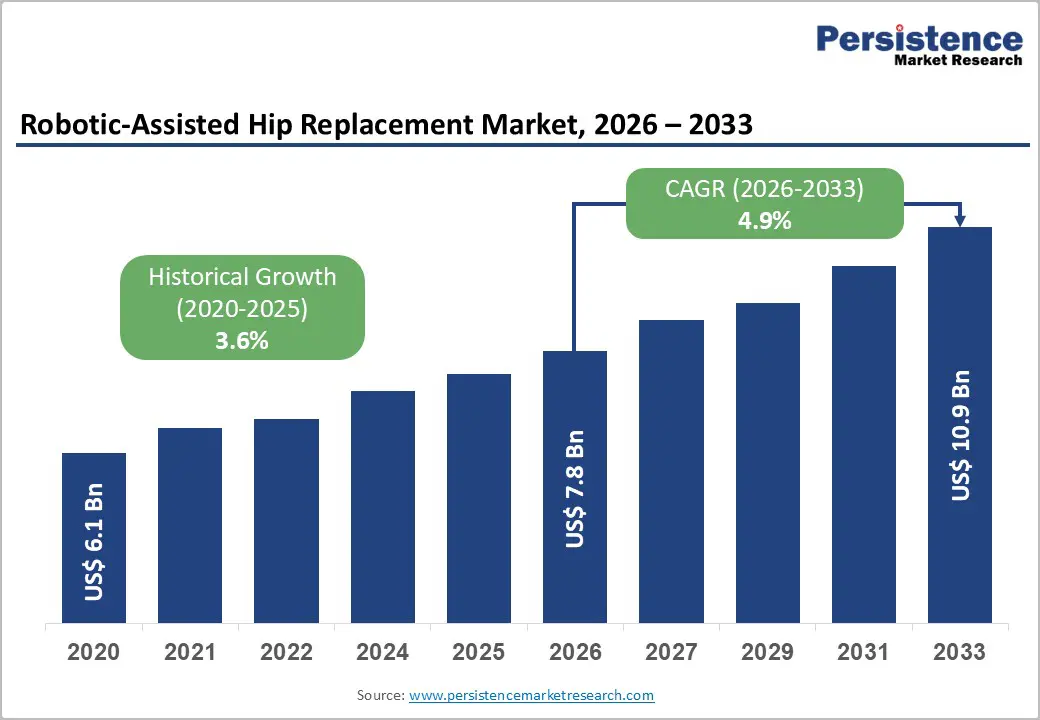
BRENFORD, LONDON, UNITED KINGDOM, May 20, 2026 /EINPresswire.com/ -- The global robotic-assisted hip replacement market is gaining steady momentum as hospitals, orthopedic centers, and surgical technology providers focus on improving precision in joint replacement procedures. According to Persistence Market Research, the market is likely to be valued at US$ 7.8 billion in 2026 and is projected to reach US$ 10.9 billion by 2033, growing at a CAGR of 4.9% during 2026–2033. Growth is supported by rising hip osteoarthritis cases, increasing demand for minimally invasive orthopedic surgery, and greater adoption of robotic platforms that help surgeons improve implant positioning, alignment, and patient outcomes.
Robotic-assisted hip replacement systems are becoming important in modern orthopedic care because they support preoperative planning, real-time surgical guidance, and improved procedural consistency. The leading segment is expected to remain robotic surgical systems and related planning software, as healthcare providers prioritize accuracy and workflow efficiency. Hospitals represent a major end-user category due to higher surgical volumes and access to advanced infrastructure. North America is expected to remain a leading geographical region, supported by strong healthcare spending, early technology adoption, skilled orthopedic surgeons, and rising patient preference for advanced hip replacement procedures.
Want Market Insights? Get Your Free Report Sample : https://www.persistencemarketresearch.com/samples/32744
Key Highlights from the Report
➤ The global robotic-assisted hip replacement market is likely to reach US$ 7.8 billion in 2026 and US$ 10.9 billion by 2033, growing at a CAGR of 4.9%.
➤ Rising demand for accurate implant placement is increasing the use of robotic-assisted orthopedic surgery.
➤ Hospitals are adopting robotic platforms to improve surgical planning, reduce variability, and enhance patient recovery outcomes.
➤ North America remains a key market due to advanced orthopedic infrastructure and strong technology acceptance.
Market Segmentation
The robotic-assisted hip replacement market can be segmented by product type into robotic systems, surgical instruments, software platforms, and related accessories. Robotic systems hold strong importance because they directly support surgical accuracy and procedural control. Software and planning tools are also gaining relevance as surgeons increasingly rely on digital imaging, 3D planning, and data-driven guidance before and during procedures.
By end-user, the market includes hospitals, ambulatory surgical centers, and orthopedic specialty clinics. Hospitals lead the market due to higher patient inflow, availability of trained surgeons, and capacity to invest in advanced surgical robotics. Ambulatory surgical centers are gradually gaining traction as minimally invasive procedures and faster recovery models become more common in orthopedic care.
Customize This Report for Your Exact Requirements : https://www.persistencemarketresearch.com/request-customization/32744
Regional Insights
North America is expected to remain a leading region in the robotic-assisted hip replacement market. The region benefits from strong healthcare infrastructure, higher adoption of advanced surgical technologies, and growing awareness among patients about precision-based hip replacement procedures. Favorable access to orthopedic specialists also supports market growth.
Europe is witnessing steady adoption due to rising joint replacement volumes and improving hospital investment in robotic surgery. Asia Pacific is expected to offer future growth potential as healthcare modernization, medical tourism, and demand for advanced orthopedic care continue to expand across major economies.
Unlock Complete Insights – Buy the Full Report : https://www.persistencemarketresearch.com/checkout/32744
Market Drivers
The key driver of the robotic-assisted hip replacement market is the rising need for improved surgical accuracy. Robotic systems help surgeons plan procedures more effectively, position implants with greater precision, and reduce inconsistencies during surgery. This is especially important as patients increasingly expect better mobility, shorter recovery periods, and long-lasting implant performance.
Another major growth driver is the increasing burden of hip disorders among aging populations. Conditions such as osteoarthritis, fractures, and degenerative joint diseases are raising the demand for hip replacement procedures. As healthcare providers focus on better clinical outcomes, robotic-assisted solutions are becoming more attractive in orthopedic surgery.
Market Restraints
High installation and maintenance costs remain a major restraint for the robotic-assisted hip replacement market. Robotic surgical platforms require significant capital investment, which can limit adoption among smaller hospitals and clinics. Additional costs related to training, software updates, and specialized instruments may also affect purchasing decisions.
Another restraint is the need for skilled surgeons and technical staff. Robotic-assisted procedures require proper training and workflow adaptation. In regions with limited access to advanced orthopedic training, adoption may progress slowly despite growing interest in surgical robotics.
Market Opportunities
The market offers strong opportunities in emerging healthcare systems where orthopedic infrastructure is improving. As hospitals upgrade surgical departments and patients seek advanced treatment options, demand for robotic-assisted hip replacement procedures is expected to rise. Medical tourism may also support adoption in countries offering cost-effective advanced surgery.
Future opportunities also exist in software innovation, AI-enabled planning, and improved robotic navigation systems. Companies that focus on user-friendly platforms, better imaging integration, and cost-efficient robotic solutions may gain a competitive edge as hospitals look for practical and scalable technologies.
Company Insights
Key players operating in the robotic-assisted hip replacement market include Stryker Corporation, Zimmer Biomet Holdings, Inc., Smith+Nephew, Johnson & Johnson Services, Inc., Medtronic plc, THINK Surgical, Inc., Corin Group, Globus Medical, Inc., and MicroPort Scientific Corporation.
Explore the Latest Trending Research Reports:
Surgical Lamps Market
Telemedicine Market
Persistence Market Research
Persistence Market Research Pvt Ltd
+1 646-878-6329
email us here
Visit us on social media:
LinkedIn
Instagram
Facebook
YouTube
X
Legal Disclaimer:
EIN Presswire provides this news content "as is" without warranty of any kind. We do not accept any responsibility or liability for the accuracy, content, images, videos, licenses, completeness, legality, or reliability of the information contained in this article. If you have any complaints or copyright issues related to this article, kindly contact the author above.
