

Following the news from the United Kingdom
Provided by AGP
Non-destructive homogeneity measurement for transparent cylindrical materials without slicing
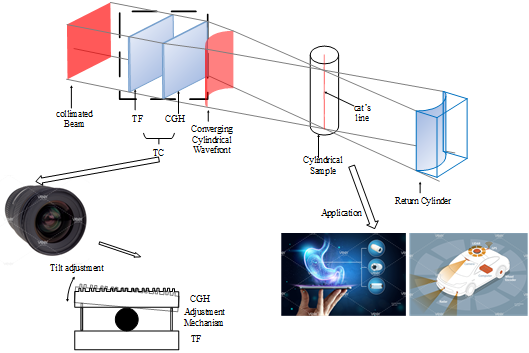
Figure 1 illustrates the test optical path for cylindrical homogeneity interferometry.
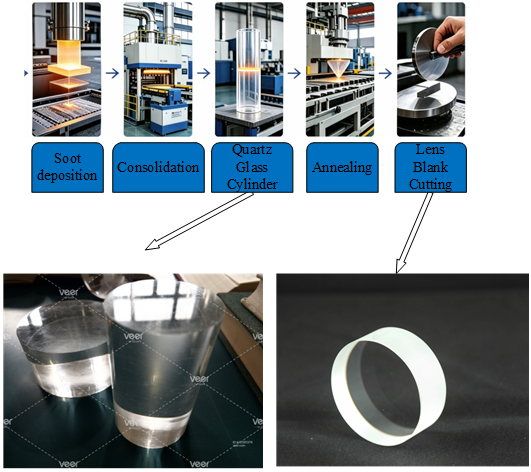
Fig 2. Different stages of the quartz manufacturing process
FAYETTEVILLE, GA, UNITED STATES, May 6, 2026 /EINPresswire.com/ -- Current homogeneity testing has long relied on a planar “slice‑then‑measure” approach. Professor Sen Han’s team proposes a radial absolute measurement method for cylindrical surfaces. This method requires no slicing, is low‑cost, and enables direct non‑destructive measurement of refractive index distribution, offering an efficient pre‑screening tool for semiconductors, LiDAR, medical imaging, and more.
Optical homogeneity is generally defined as the ratio of the maximum refractive index variation inside a component to its average refractive index. It directly determines imaging quality, beam stability, and measurement accuracy, making it a core quality indicator for high‑end optical components. With the rapid development of LiDAR, medical imaging, semiconductor manufacturing, and other industries, the demand for accurate homogeneity of cylindrical transparent materials is increasing. Currently, the market has long relied on the traditional “slice‑then‑measure” scheme: cutting a cylindrical ingot into a thin optical flat, measuring the optical flat with planar homogeneity testing methods, and then processing only the qualified optical flat. This approach has an inherent flaw: if the entire cylindrical ingot fails the homogeneity specification, all optical flats are scrapped, resulting in huge material waste and cost loss.
Recently, a research team led by Professor Sen Han from the University of Shanghai for Science and Technology, with Zechuan Wei as the first author, published a paper titled “Simulation and experimental investigation of homogeneity measurement in side‑polished transparent cylindrical materials” in Light: Advanced Manufacturing. The study proposes a radial absolute measurement method for refractive index homogeneity of transparent cylindrical materials based on a Fizeau interferometer, successfully achieving non‑destructive, high‑precision inspection of the internal refractive index distribution of cylindrical ingots at the ingot stage. This method eliminates the “slice‑then‑measure” workflow. It can be widely applied to quality control of key products such as semiconductor silicon ingots, medical endoscope cylindrical windows, and LiDAR optical components.
The transmission cylinder (TC) used by the research team is essentially a combination of a high‑precision transmission flat (TF) and a computer‑generated hologram (CGH). The TF provides a stable reference optical path, while the CGH acts like a custom‑made “stamp” that “stamps” the standard plane wave from the interferometer into the required cylindrical wave. More cleverly, this integrated design permanently locks the TC's optical axis to the interferometer's optical axis. Once aligned, it can be used for a long time without re‑alignment, making it easy to obtain cylindrical surface interferograms.
The interferogram contains systematic errors and errors from various surfaces. The team adopted an absolute measurement method: measure four sets of interference data: empty cavity, transmission through the sample, front‑surface reflection, and back‑surface reflection. Through mathematical combination, even with the coordinate‑mirror‑reversal characteristic of cylindrical geometry, the figure error of the reference mirror, the surface error of the sample, and the alignment error of the return mirror cancel each other out, leaving only the internal refractive‑index distribution of the sample. This is like taking a photo of the background first, then a photo with a person. Subtract the two, and the person is “cut out” – the messy background no longer matters.
This study proposes a radial absolute measurement method for homogeneity of transparent cylindrical materials, providing a “no‑slice, non‑destructive” raw material pre‑screening tool for products such as semiconductor ingots, LiDAR optics, and medical endoscope windows. It significantly reduces costs and fills the technical gap in absolute homogeneity measurement for cylindrical components. In the future, this method is expected to be combined with stitching measurement techniques to achieve full‑volume homogeneity imaging of entire cylinders, and even to enter production lines as a routine means of online non‑destructive inspection
References
DOI
10.37188/lam.2026.053
Original Source URL
https://doi.org/10.37188/lam.2026.053
Funding Information
This work was supported by the National Key R&D Program of China under Grant No. 2022YFF0607701.
Lucy Wang
BioDesign Research
email us here
Legal Disclaimer:
EIN Presswire provides this news content "as is" without warranty of any kind. We do not accept any responsibility or liability for the accuracy, content, images, videos, licenses, completeness, legality, or reliability of the information contained in this article. If you have any complaints or copyright issues related to this article, kindly contact the author above.
