

Role of GSK2118436(Dabrafenib) in Landmark PDAC Study: Selleckchem Empowering RAS-GTP Synergistic Research
Selleckchem Global Impact. Selleck Chemicals products have been cited in over 600 studies published in Nature, Science, and Cell, reflecting the high level of trust and pharmacological precision the brand provides to the global scientific community.
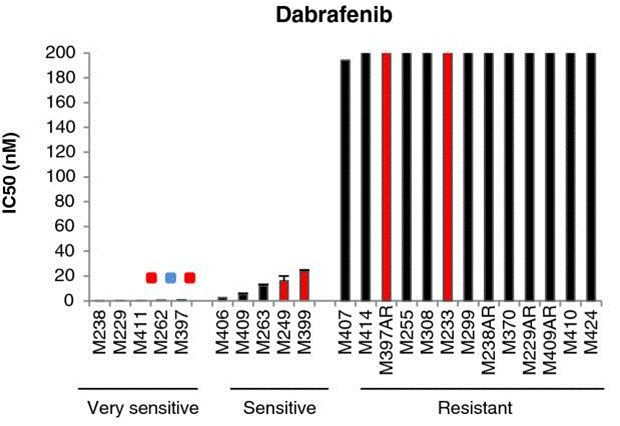
Sensitivity profile of Dabrafenib (GSK2118436) across multiple cell models, highlighting its varying $IC_{50}$ potency in sensitive versus resistant oncogenic lineages.
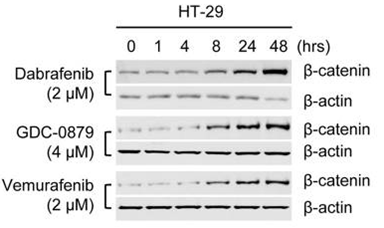
Western Blot analysis demonstrating the time-dependent effect of Dabrafenib on $\beta$-catenin expression in HT-29 cells compared to other BRAF inhibitors.
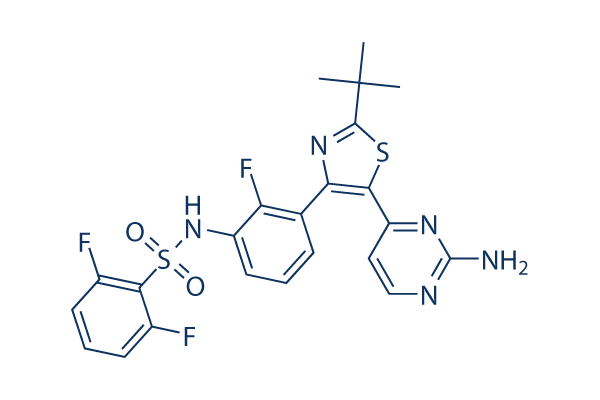
Chemical structure of Dabrafenib (GSK2118436)
Selleckchem empowers Nature-published PDAC study: GSK2118436 proves vital for MAPK pathway inhibition and overcoming resistance.
HOUSTON, TX, UNITED STATES, April 22, 2026 /EINPresswire.com/ -- GSK2118436 (Dabrafenib), a flagship high-purity compound provided by Selleck Chemicals, is emerging as a critical tool in the global effort to treat Pancreatic Ductal Adenocarcinoma (PDAC). PDAC has long been characterized as the "king of cancers" due to its dismal survival rates and profound resistance to conventional therapies. A transformative study recently published in the prestigious journal Nature (Vol 629, 23 May 2024), titled "Tumour-selective activity of RAS-GTP inhibition in pancreatic cancer," has unveiled a major breakthrough in broad-spectrum RAS-GTP inhibition. As researchers pivot toward precision oncology, the strategic integration of Selleck’s GSK2118436 has proven to be a vital component in validating life-saving synergistic effects and providing a sophisticated roadmap for future clinical interventions against RAS-addicted malignancies.This research highlights the potent anti-tumor activity of multi-selective RAS(ON) inhibitors, which target the active, GTP-bound forms of KRAS, HRAS, and NRAS. By demonstrating a superior therapeutic index and the ability to overcome common resistance mechanisms, these findings provide a robust scientific rationale for novel combination strategies. Most notably, the study opens the door for integrating targeted agents such as GSK2118436—a potent BRAF inhibitor—to achieve deeper, more durable inhibition of the MAPK signaling pathway. As researchers pivot toward precision oncology, the strategic integration of GSK2118436 has proven to be a vital component in validating these life-saving synergistic effects, providing a sophisticated roadmap for future clinical interventions against RAS-addicted malignancies.
Led by Professor Kenneth P. Olive, this groundbreaking study utilized the tool compound RMC-7977 to evaluate the efficacy of next-generation RAS(ON) tri-complex inhibitors. Since over 90% of PDAC cases are driven by KRAS mutations, the research team employed a comprehensive array of models—including human PDAC cell lines, patient-derived organoids (PDOs), and the highly chemoresistant KPC autochthonous mouse model—to simulate real-world therapeutic challenges.
The study’s conclusions highlight three transformative findings:
Exceptional Therapeutic Index: Unlike traditional inhibitors, RAS-GTP inhibition triggers intense waves of apoptosis and sustained proliferative arrest specifically within tumor tissues. Conversely, normal tissues (such as skin and colon) experienced only transient decreases in proliferation with no evidence of cell death, demonstrating a remarkable window of safety.
A Narrower Path to Resistance: Broad-spectrum RAS inhibition (targeting KRAS, HRAS, and NRAS) prevents the rapid "escape" seen with mutation-specific inhibitors. While relaying on Myc copy number gains as a primary resistance mechanism, the study found this could be neutralized through combinatorial inhibition, such as targeting the YAP-TEAD pathway.
Unprecedented Survival Extension: In the gold-standard KPC model, RMC-7977 treatment resulted in a 3.5-fold increase in median survival. This performance vastly outperforms the current standard of care, Gemcitabine, which typically fails to alter survival outcomes in this aggressive model.
These results establish a robust preclinical rationale for broad-spectrum RAS(ON) inhibition as a monotherapy or in combination with MAPK-modulating agents like Dabrafenib (GSK2118436).
While the Nature study focuses on the direct inhibition of RAS-GTP, the underlying data reveals a critical nuance: KRAS wild-type (WT) pancreatic cancer cell lines harboring BRAF mutations exhibit distinct sensitivity profiles. As a high-potency, selective BRAF V600 inhibitor, GSK2118436 remains a cornerstone in deciphering these complex signaling networks.
GSK2118436 plays a multi-faceted role in current PDAC research
The multi-faceted role of Dabrafenib (GSK2118436) in contemporary pancreatic ductal adenocarcinoma (PDAC) research extends far beyond its traditional clinical applications, serving as a cornerstone for dissecting the complexities of the MAPK signaling hierarchy. In the context of the RAF-MEK-ERK axis, which remains the primary engine for adaptive feedback activation when upstream RAS is pharmacologically suppressed, Dabrafenib offers critical synergistic potential. By precisely targeting and neutralizing the BRAF node, this inhibitor prevents the rapid pathway reactivation that often renders monotherapies ineffective, providing a vital mechanism for achieving sustained vertical inhibition of oncogenic signaling.
Furthermore, for the specific 1–2% subset of PDAC patients harboring BRAF mutations, Dabrafenib serves as the definitive baseline for targeted precision medicine, offering a tailored approach to a disease historically treated with broad-spectrum cytotoxics. Beyond direct therapy, it has become an essential pharmacological tool in resistance studies, particularly when investigating non-canonical escape mechanisms such as Myc copy number gains or YAP pathway activation. By utilizing Dabrafenib as a standard control or combinatorial agent, researchers can surgically isolate MAPK dependency, allowing for the strategic deconstruction of bypass signaling and the development of more durable treatment regimens against RAS-addicted malignancies.
New Countermeasures: From MYC to the YAP Pathway
The study found that relapsed tumors following RAS-GTP inhibition often exhibit Myc copy number gains, a resistance mechanism closely linked to the activation of the YAP-TAZ-TEAD pathway.
Current conclusions suggest that combining RAS inhibitors with TEAD inhibitors (such as IAG933) can effectively overcome monotherapy resistance. This evolution in strategy underscores the necessity of multi-node pathway blockade, positioning Dabrafenib as a vital component in research focusing on dual-pathway inhibition and "vertical" suppression of the signaling hierarchy.
"In recent years, we have seen Dabrafenib (GSK2118436) transcend its role as a clinical therapeutic to become an indispensable analytical tool in complex signaling crosstalk studies," says Dr. Eric A. Zhang from Selleck Chemicals. "As researchers move toward 'mutation-agnostic' RAS inhibitors, the ability to selectively shut down BRAF signaling with GSK2118436 allows for a surgical deconstruction of the MAPK pathway. At Selleck, we are committed to providing high-purity Dabrafenib to ensure that these sophisticated combinatorial studies—mapping everything from MYC-driven resistance to YAP/TAZ bypass signaling—are built on a foundation of pharmacological precision."
Selleck Chemicals: Ensuring Pharmacological Precision in Global Research
As a global leader in high-performance bioactive small molecules, Selleck Chemicals provides the research community with GSK2118436 (Dabrafenib) of unparalleled quality and purity. Recognizing that the reproducibility of high-impact studies—like those published in Nature—depends on the integrity of the chemical tools used, Selleck employs rigorous HPLC and NMR validation for every batch. The high-purity GSK2118436 is specifically designed to support complex combinatorial signaling research, ensuring that researchers can explore MAPK crosstalk, MYC-driven resistance, and YAP pathway bypass with total confidence in their experimental results.
The findings published in Nature solidify RAS as the central therapeutic target in pancreatic cancer while offering a transformative perspective on signaling networks. As the scientific community explores the next frontier—integrating direct RAS inhibition with the vertical suppression of the MAPK pathway—GSK2118436 remains an indispensable tool. High-purity Dabrafenib from Selleck Chemicals will continue to empower investigators in delivering deeper, more durable clinical breakthroughs for patients worldwide.
Frank Mosby
Selleck Chemicals LLC
+86 138 1801 5024
email us here
Legal Disclaimer:
EIN Presswire provides this news content "as is" without warranty of any kind. We do not accept any responsibility or liability for the accuracy, content, images, videos, licenses, completeness, legality, or reliability of the information contained in this article. If you have any complaints or copyright issues related to this article, kindly contact the author above.
