

Precision Medicine Market Growing at 9.3% CAGR Through 2033 | Persistence Market Research
precision medicine market
Precision medicine focuses on personalized healthcare using genetic insights, advanced diagnostics, and targeted therapies to improve treatment outcomes.
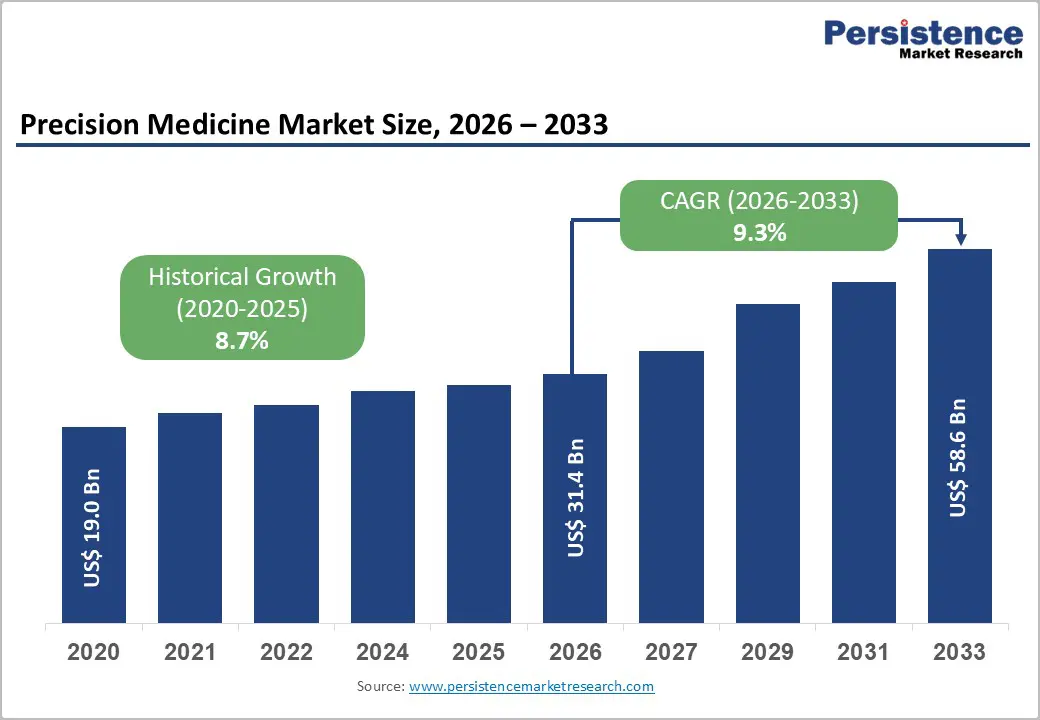
LONDON, UNITED KINGDOM, April 1, 2026 /EINPresswire.com/ -- The precision medicine market is experiencing strong growth, driven by rapid advances in genomic science, data analytics, and targeted therapeutics. The market is expected to reach approximately US$ 31.4 billion in 2026 and expand to nearly US$ 58.6 billion by 2033, registering a compound annual growth rate (CAGR) of 9.3% during the forecast period. This growth reflects a shift from traditional treatment models toward personalized healthcare strategies that consider individual genetic, environmental, and lifestyle factors.
Increasing global disease burden, particularly cancer, is a key factor accelerating adoption. Precision medicine has demonstrated significantly improved treatment outcomes through biomarker-driven therapies, which show higher response rates compared to conventional approaches. Additionally, large-scale initiatives such as the National Institutes of Health All of Us Research Program are strengthening research infrastructure and enabling broader access to genomic data, further supporting market expansion.
Download Your Free Sample & Explore Key Insights: https://www.persistencemarketresearch.com/samples/12646
Market Dynamics
Growth Drivers
One of the primary growth drivers is the increasing integration of next-generation sequencing (NGS) technologies into clinical practice. Advances in sequencing speed, accuracy, and cost efficiency have made genomic testing more accessible to hospitals and diagnostic laboratories. Declining sequencing costs are enabling widespread adoption across oncology, rare diseases, and pharmacogenomics, improving early diagnosis and treatment precision.
Another major factor is the rising prevalence of chronic diseases such as cancer, cardiovascular conditions, and diabetes. Precision medicine enables clinicians to tailor treatments based on genetic and molecular profiles, reducing adverse effects and improving outcomes. Companion diagnostics play a crucial role in identifying patient-specific biomarkers, guiding therapy selection, and enhancing clinical decision-making.
Market Restraints
Despite its potential, the market faces challenges related to high implementation costs and infrastructure requirements. Establishing advanced genomic laboratories requires significant capital investment in sequencing platforms, bioinformatics tools, and skilled personnel. Additionally, personalized therapies such as CAR-T treatments involve complex manufacturing processes, resulting in high treatment costs that limit accessibility in developing regions.
Healthcare disparities also remain a concern, as many emerging economies lack the infrastructure needed for routine genomic testing. These barriers may slow adoption in resource-constrained settings.
Market Opportunities
Significant opportunities exist in oncology, particularly with the expansion of CAR-T cell therapies and multi-omics approaches. Integrating genomics, proteomics, and metabolomics provides deeper insights into disease mechanisms, enabling highly personalized treatment strategies. This is encouraging pharmaceutical and biotechnology companies to invest in targeted therapies and companion diagnostics.
Artificial intelligence (AI) is also transforming the market by enabling rapid analysis of large genomic datasets. AI-driven platforms improve diagnostic accuracy, accelerate biomarker discovery, and support real-time treatment optimization. Companies such as IBM are actively developing AI-based healthcare solutions, highlighting the growing importance of data-driven precision medicine.
Get Custom Insights Designed for Your Businecss: https://www.persistencemarketresearch.com/request-customization/12646
Category-wise Insights
Product and Service Analysis
Consumables and reagents dominate the market, accounting for a significant share due to their recurring use in genomic testing workflows. These include sequencing kits, assay materials, and sample preparation tools essential for diagnostic procedures. Companies like Illumina lead this segment by supplying reagents used in millions of tests annually, ensuring steady revenue streams.
Technology Analysis
NGS technology holds the largest market share due to its critical role in genomic profiling. Continuous advancements have significantly reduced sequencing costs while improving accuracy and turnaround time. These improvements have expanded the use of NGS beyond research into routine clinical applications, including newborn screening and cancer diagnostics.
End User Analysis
Hospitals and clinics represent the largest end-user segment, supported by their advanced infrastructure and integrated care capabilities. These facilities provide comprehensive services, including genetic testing, diagnosis, treatment, and monitoring. The complexity of precision therapies requires specialized medical teams and equipment, making hospitals the primary centers for implementation.
Regional Insights
North America leads the precision medicine market, driven by advanced healthcare infrastructure, strong research funding, and early adoption of innovative technologies. The region benefits from active participation by leading companies such as Pfizer and Novartis, which invest heavily in targeted therapies and genomic research.
Asia Pacific is the fastest-growing region, supported by expanding healthcare access, increasing cancer incidence, and government-led genomics initiatives. Countries like China and India are investing in large-scale sequencing programs and digital health infrastructure, making precision medicine more accessible to broader populations.
Competitive Landscape
The market is moderately competitive, with major players including Roche, Thermo Fisher Scientific, and AstraZeneca driving innovation through research and strategic partnerships. Emerging biotechnology firms are also contributing by developing niche technologies such as liquid biopsies and AI-based analytics.
Checkout Now & Download Complete Market Report: https://www.persistencemarketresearch.com/checkout/12646
Market Segmentation
Product & Service
Instruments
Consumables & Reagents
Software
Services
Application
Oncology
Neurology
Immunology
Cardiovascular
Rare Diseases
Infectious Diseases
Others
Technology
Gene Sequencing / NGS
Bioinformatics & Data Analytics
PCR & Molecular Diagnostics
Pharmacogenomics
AI-based Platforms
End User
Hospitals & Clinics
Diagnostic Laboratories
Pharma & Biotech Companies
Research Institutes
Regions
North America
Europe
East Asia
South Asia & Oceania
Latin America
Middle East & Africa
Overall, the precision medicine market is poised for sustained growth, supported by technological advancements, increasing disease burden, and growing emphasis on personalized healthcare solutions worldwide.
Read Related Report:
Macular Degeneration Treatment Market: The global macular degeneration treatment market is projected to grow from US$16.8 Bn in 2026 to US$27.6 Bn by 2033, expanding at a CAGR of 5.2%.
OTC Scar Treatment Market: The global OTC scar treatment market is projected to grow from US$ 10.6 Bn in 2026 to US$ 17.4 Bn by 2033, at a 6.5% CAGR forecast 2026–2033.
Persistence Market Research
Persistence Market Research Pvt Ltd
+1 646-878-6329
email us here
Visit us on social media:
LinkedIn
Instagram
Facebook
YouTube
X
Legal Disclaimer:
EIN Presswire provides this news content "as is" without warranty of any kind. We do not accept any responsibility or liability for the accuracy, content, images, videos, licenses, completeness, legality, or reliability of the information contained in this article. If you have any complaints or copyright issues related to this article, kindly contact the author above.
