

Organic Acid Market Forecast 2026–2036: Global Market to Reach USD 23.8 Billion by 2036 at 5.5% CAGR
Organic Acid Market
Organic acid demand accelerates as bioplastics and antibiotic-free livestock reshape supply chains amid tightening fermentation capacity.
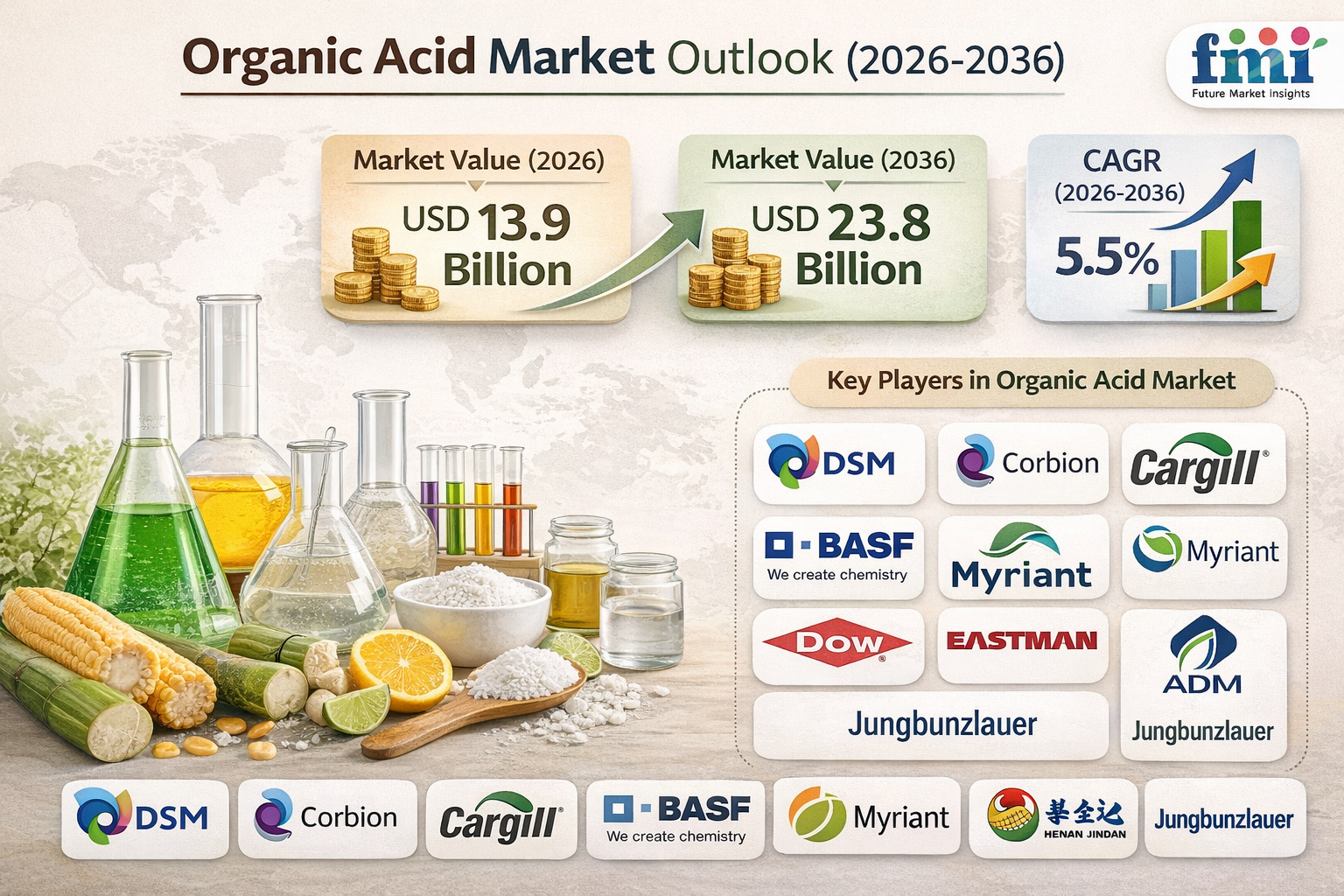
NEWARK, DE, UNITED STATES, February 23, 2026 /EINPresswire.com/ -- The global organic acid market is entering a structurally transformative decade. Valued at an estimated USD 13.2 billion in 2025, the market is projected to grow to USD 13.9 billion in 2026 and further expand to USD 23.8 billion by 2036, registering a CAGR of 5.5%.
This growth trajectory signals more than cyclical expansion. Organic acids are evolving from traditional pH regulators into strategic enablers for bioplastics production and antibiotic-free livestock systems, reshaping procurement and investment priorities across food, feed, and industrial biotechnology.
According to analysis by Future Market Insights (FMI), tightening fermentation capacity and rising capital expenditure are redefining competitive dynamics. Supply-side friction intensified in July 2024 when ADM and LG Chem paused their planned lactic acid joint ventures, citing escalating construction costs. Chris Cuddy, President of ADM Carbohydrate Solutions, noted that soaring build expenses forced the decision to halt expansion — a move that underscores the capital discipline shaping the sector.
As greenfield capacity additions slow, incumbent producers with depreciated assets are pivoting toward high-margin applications such as feed acidifiers and bio-based polymers, deprioritizing commodity food acidulants. Buyers are increasingly locking in long-term contracts to hedge against spot market volatility.
Market Definition and Scope
The organic acid market encompasses weak acids produced primarily via microbial fermentation of sugar, molasses, or corn substrates, as well as select synthetic routes. Core products include citric, lactic, formic, propionic, acetic, and malic acids used across:
• Food preservation and acidification
• Poultry and livestock feed acidifiers
• Pharmaceutical intermediates
• Bioplastics monomers (PLA)
• Industrial cleaning and textile processing
The scope excludes inorganic mineral acids and amino acids unless part of blended acidifier systems.
Segmental Performance Highlights
By Product Type
Citric acid commands 12.2% market share in 2026, maintaining volume leadership due to established fermentation economics and widespread use in beverages and detergents. Lactic acid is gaining momentum, supported by expanding global bioplastics capacity, forecast to more than triple between 2023 and 2028.
Feedstock availability remains pivotal. Global sugar output and corn processing volumes directly influence fermentation margins, while sustainability-linked procurement is pushing manufacturers toward energy-efficient production systems.
By Application
Poultry and farming account for 32.3% of total demand in 2026. Organic acids are integral to antibiotic-free livestock strategies, lowering gut pH and inhibiting pathogenic bacteria. With antimicrobial resistance intensifying regulatory scrutiny worldwide, acidifiers are emerging as structural replacements for growth promoters.
Market Drivers and Structural Pressures
The expansion of compound feed production globally is the primary volume driver. As protein consumption rises, technical demand for feed preservation and gut-health additives scales proportionately.
However, volatility in sugar and corn prices continues to compress fermentation margins. Additionally, high capital requirements for new facilities restrict supply elasticity, particularly in capital-intensive segments like polylactic acid.
Environmental regulations on effluent discharge and carbon intensity in Europe and parts of Asia add further cost pressures. Analysts at FMI highlight that downstream purification — often energy-intensive — could challenge global trade competitiveness in price-sensitive regions.
Strategic Implications for CXOs
Executives are recalibrating growth strategies in response to constrained capacity and rising costs:
• Secure long-term feedstock contracts to mitigate sugar and dextrose volatility
• Diversify sourcing beyond single-country dependence to hedge against anti-dumping duties and logistics disruptions
• Strengthen technical sales teams to support customized feed acidifier formulations
• Leverage digital sales platforms to optimize fragmented customer portfolios
Between 2026 and 2036, integrated producers with feedstock access and advanced fermentation efficiency are expected to outperform.
Regional Outlook
Growth patterns reflect varying intensities of industrial biotechnology adoption:
• India: 7.2% CAGR, supported by modernization of poultry operations and strong sugar production base
• UK: 5.8% CAGR, driven by stringent biosecurity standards
• USA: 5.7% CAGR, supported by bio-based chemical innovation and food waste valorization
• Germany: 5.6% CAGR, anchored in high-spec industrial acid production
• China: 5.5% CAGR, sustained by manufacturing scale and bio-economy infrastructure
• Brazil: 5.4% CAGR, benefiting from agricultural integration
Asia Pacific remains the global production powerhouse, while Europe emphasizes sustainability-driven premiumization. North America is increasingly focused on domestically sourced bio-based inputs.
Competitive Landscape
The industry is bifurcated between large integrated producers and specialized functional ingredient companies. Feedstock integration, energy efficiency, and sustainability certifications are becoming decisive differentiators.
Strategic partnerships are accelerating regional penetration, while digital platforms are improving pricing transparency and procurement agility. Capital allocation discipline remains evident, with firms reassessing high-capex ventures in favor of asset optimization.
Request For Sample Report | Customize Report | Purchase Full Report - https://www.futuremarketinsights.com/reports/sample/rep-gb-159
Recent Developments
• In February 2026, dsm-firmenich agreed to divest its Animal Nutrition & Health business to CVC for approximately EUR 2.2 billion, signaling consolidation in feed additives.
• In March 2025, TotalEnergies Corbion partnered with Benvic to expand low-carbon PLA applications in automotive and electronics sectors.
Competitive Players
Key companies operating in the organic acid market include DSM, Corbion, Cargill, BASF, Myriant, Henan Jindan, Dow, Eastman, ADM, and Jungbunzlauer.
For investors and procurement leaders, the decade ahead points toward firmer pricing, disciplined capacity expansion, and accelerated adoption of bio-based chemical platforms.
Browse Related Insights
Organic Pet Food Market: https://www.futuremarketinsights.com/reports/organic-pet-food-market
Organic Cocoa Market: https://www.futuremarketinsights.com/reports/organic-cocoa-market
Organic Beverages Market: https://www.futuremarketinsights.com/reports/organic-beverages-market
About Future Market Insights (FMI)
Future Market Insights, Inc. (FMI) is an ESOMAR-certified, ISO 9001:2015 market research and consulting organization, trusted by Fortune 500 clients and global enterprises. With operations in the U.S., UK, India, and Dubai, FMI provides data-backed insights and strategic intelligence across 30+ industries and 1200 markets worldwide.
Sudip Saha
Future Market Insights Inc.
+ +1 347-918-3531
email us here
Legal Disclaimer:
EIN Presswire provides this news content "as is" without warranty of any kind. We do not accept any responsibility or liability for the accuracy, content, images, videos, licenses, completeness, legality, or reliability of the information contained in this article. If you have any complaints or copyright issues related to this article, kindly contact the author above.
